Cradle-to-gate product footprints for metal parts

The realest footprint your supply chain can produce, without the burden.

When it comes to calculating your product footprints, most tools leave you with a spend-based guess or a data request your suppliers never finish. COCO works from the documents your suppliers already have and lets them fill any remaining gaps via a tailored fallback system. It then runs the full calculation automatically and returns a cradle-to-gate footprint. Light on your suppliers, hands-off for your team. Focused on stamped and formed metal parts.

The problem

Getting supplier data and running the calculation is the hard part.

The number is simple in theory. Getting real data out of your suppliers, many of them small shops with no sustainability staff, and then running the calculation is what takes the time. Most of it goes into chasing suppliers and re-keying what they send, and it starts again each time a new customer asks.

What COCO does

From supplier documents to a customer-ready footprint file.

Supplier document step

Connect

Send each supplier one clear request for the documents they already have: invoices, BOMs, material certs. Plain language, their own language, no portal training.

Audit panel showing full calculation

Calculate

COCO runs the full cradle-to-gate calculation (A1 to A3): material inputs, inbound transport, factory energy, allocated to the part. Where a figure is still missing after the tailored fallback, COCO uses an estimate, clearly labelled as one.

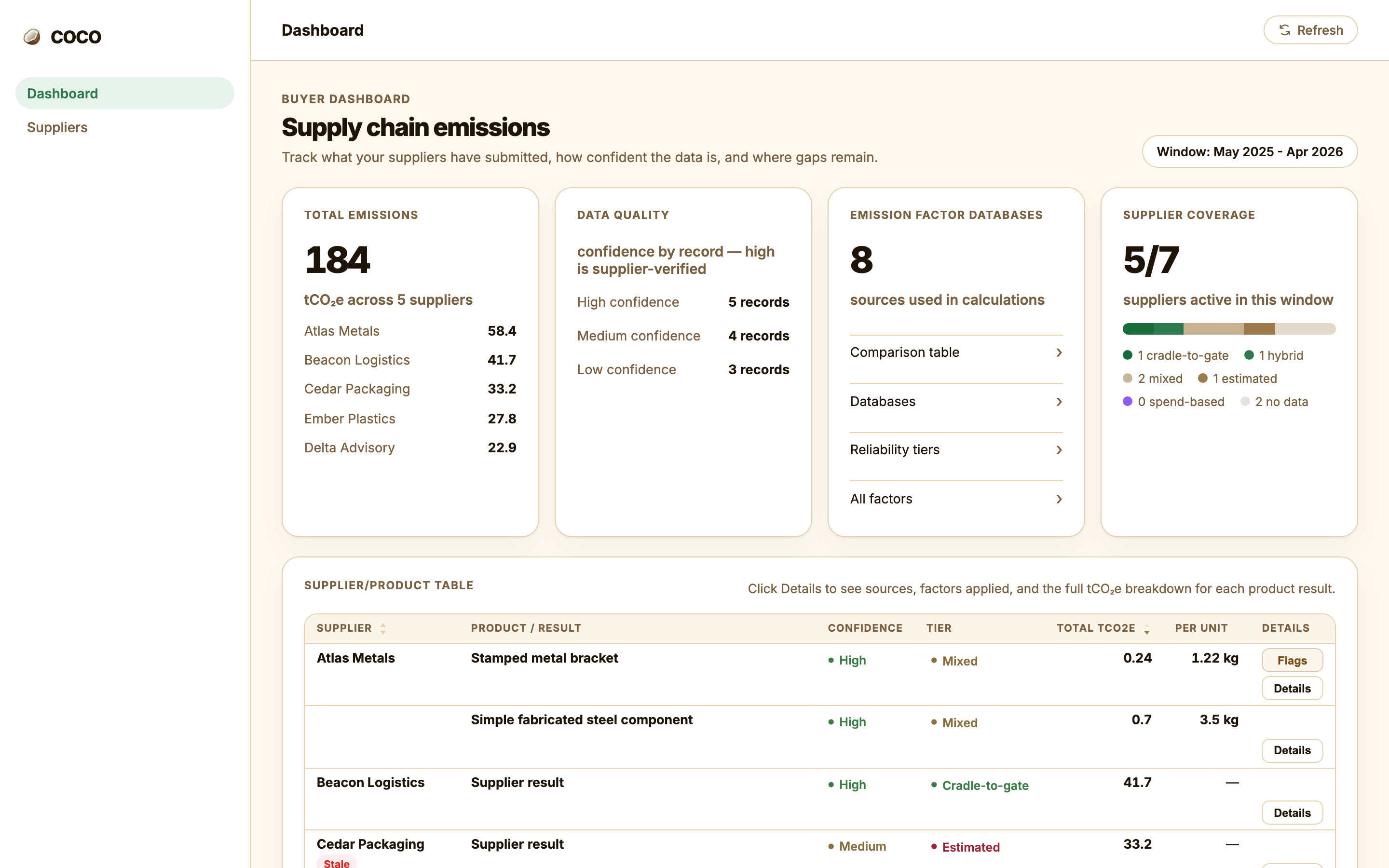
Buyer dashboard with emissions overview

Report

A cradle-to-gate footprint file, aligned with the PACT and GHG Protocol methods, in the format your customer's system expects (SiGREEN, SAP SDX, Catena-X). Every number opens into a full audit panel showing how it was calculated.

The supplier experience

Suppliers upload documents. COCO does the rest.

No questionnaires. No sustainability knowledge needed. Suppliers open a personalised link in their own language, upload the documents they already have: invoices, BOMs, material certs, energy bills, and confirm what was extracted. Most finish in under ten minutes.

  • No accounts to create, no portal onboarding
  • Accepted in any language
  • PDF, Excel, CSV, or Word: whatever they have
  • Estimates accepted where exact figures aren't available
A1-A3
the cradle-to-gate boundary COCO covers, the same boundary Catena-X and PACT use.
2025
BMW made Catena-X registration part of procurement. VW, Mercedes-Benz and Ford are following.
v3
the current PACT methodology. COCO's calculation is aligned with it, not certified against it.

How it works

From supplier request to customer-ready file.

01
List the parts and suppliers
Start from the parts your customer asked about and the suppliers behind them. A spreadsheet is enough to begin.
02
Collect the documents
Suppliers open a personalised link, upload the documents they already have (invoices, BOMs, material certs, energy bills), and confirm what was extracted. For anything the documents do not cover, a tailored fallback walks them through it: a few targeted questions first, and a clearly labelled estimate only for what is still missing after that.
03
Hand it to your customer
Export a cradle-to-gate footprint in the format your customer's system expects, with a full audit panel behind every figure showing how it was calculated.

Full transparency

Every number opens up to show how it was built.

Click any product on the dashboard and COCO shows the full calculation: data extracted from the supplier's documents, the named emission factor applied to each input, and the result: materials, transport, and allocated factory energy, line by line, down to the total.

Automated

COCO does the maths

Normalises units, applies emission factors, and allocates factory energy down to your part. No spreadsheets, no factor lookups on your side.

Private

Source-linked, not stored

Every value records the supplier document it was taken from and the named emission factor applied, with source and database cited per line. The uploads themselves are deleted once the supplier confirms, so their documents never sit on our servers.

Confidence

A confidence level on every input

High means AI-extracted from a document. Medium means supplier-entered. Low means an estimate. You can see exactly how solid each number is.

Tiers

A data tier on every product

Each result is rated LCA-backed, confirmed, mixed, or estimated, so you can distinguish strong primary data from a screening estimate at a glance.

Always a number

Never a blank cell

Every input resolves to primary, manual, or estimated data. A part is never missing a number. It just carries the confidence that matches how it was obtained.

Confirmed

Signed off by the supplier

Before a figure counts, the supplier confirms it. That attestation is what turns extracted data into a number you can put in a report and stand behind.

Suppliers respond because the ask is one specific document, in plain language, in their own language.
COCOFounder-led, working with early design partners

Get started

See COCO in action.

Book a 30-minute call. We will walk through your parts, the suppliers behind them, and what a customer-ready footprint file looks like for your case.

No sales scripts. One conversation about your supply chain. sales@compliancecompanion.nl